
By Joseph Romano
Spoilers Ahead!
As the shimmering gloss of the blue velvet curtains dissolves into the blue calmness of the morning sky, something seems askew. We see pleasantries in every frame – a delightful collection of red roses, the firemen wave as they pass in their truck, children cross the street to go to school – all under the spotlight of a sunny Spring morn. Still, the benevolent beauty of small-town America can dissipate in the blink of an eye, or more operatively the kink in a hose.
As this hose gets wrapped around a branch, bringing upon what is soon revealed to be the stroke of an older man, we lose control of this beauty, and water begins to violently spew rampantly in all directions. The trouble does not simply stop there. The camera continues to delve into the topsoil to reveal an ugly truth under this charming exterior. Just under the surface, the ground is teeming and hissing with insects. Similarly, Lumberton’s divide is set at Lincoln, where the pleasant allure of the town gives way to the unsightly criminal underbelly that is corrupting its soul.

As the film proceeds the impact such menacing forces enact upon this outward beauty can be seen, as the frames become shrouded in darkness. Pinks and whites morph into heavy blues, grays, and blacks. The sun-soaked morning becomes submerged by the shadows of night. The days are typically full of hope and excitement, while the nights are packed with dread. In essence, as the film unfolds, we can see that even the most picturesque beauty can become offset by a rotten core. If we cross the threshold, we are liable for the consequences. However, there is more than just despair in the future. Malevolent forces can be conquered by the illumination of the forces that lie at the other end of the spectrum – most prominently for Blue Velvet love.
Jeffrey Beaumont (Kyle MacLachlan) and Sandy Williams (Laura Dern) repeatedly observe that their world – and by extension, our own – is a strange one. Mystifying things happen and sometimes there are no answers. Sandy has a dream, which she relays to Jeffrey, in which the world has become consumed by darkness with the only solution being the emancipation of robins. To be more specific, in this scenario the robins represented love and by unleashing such love onto the dark stricken Earth it once again became radiant.

This unadulterated hope comes to fruition in the end, as a mist of joy overcomes Lumberton once more. The threat is relieved, and the robins have returned, as we see one firmly clutching an insect in its mouth. If the ominous crawling creatures that assault the viewer within the opening moments of the film clearly represent the wickedness lurking below the surface, then the battle has raged, and love has won out. Love has laid claim to the darkness that has befouled the town of Lumberton.
The robin can represent quite a bit, but most notably the onset of happiness or joy through the rejuvenation of Spring, with which the robin is commonly associated. By the time we reach our conclusion, Jeffrey and Sandy’s love for each other has led them to overcome the ugliness in the world that neither can seem to ignore. It is possible for them to accomplish this because they share a genuine love for one another, which when they put it forth back into the world will always trump those forces that would seek to cause them harm. This is the journey that David Lynch places his characters on in this film. In the end, it is a story of love and how the light can conquer the dark.
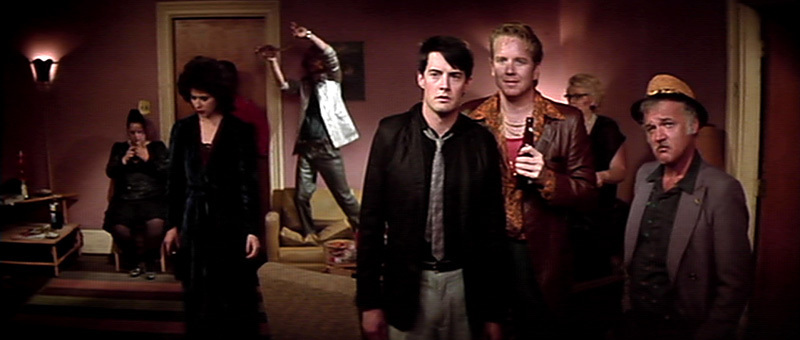
The story of the film is simply not that of good against evil, as the seedier elements are explored throughout. Maybe it does not answer every quandary about the twisted and chilling psyche of Frank Booth (Dennis Hopper), but the fact that we get a glimpse is frightening enough. He is not humanized, as he is the personification of the aforementioned darkness. He is there to be a spectacle of the unnatural, perpetuating the horrors of the world with his ring of kidnappers, sadists, and fiends. The glimpse we get into his mind most accurately comes with the onset of Roy Orbison’s “In Dreams,” which Frank demands be played at two separate points within the film.
As Ben (Dean Stockwell), the man Frank seemingly reports to, lip-synchs the song into a dethatched metallic light fixture it becomes abundantly clear that this Roy Orbison song is so thoroughly vital to Blue Velvet. After detailing the magical elements of the dream world, Orbison confesses that, “Just before the dawn, I wake and find you gone.” Frank is unable to accept this line and he therefore angrily removes his cassette, utters a vulgar declaration, and disappears to the shrill screech of tires on asphalt, as they ‘joy ride’ proceeds.

Like much of Lynch’s filmography, the world of Blue Velvet is deeply indebted to the dream world, the highs are luminous and the lows nightmarish. For the purposes of our story, Frank is the embodiment of this evil undercurrent to society, perverse and corrupted in every which way. He is thoroughly troubled, yet the point Lynch is making is that he does not live in reality. His delusions externalize his inner ugliness and perpetuate his torment onto the world because he is incapable of accepting it at face value.
Often shrouded in grays and blacks, Jeffrey is split between the two worlds that meet at the Lincoln divide in Lumberton. He cannot escape his fascination for the criminal underworld, yet he has genuine feelings for Sandy. He often appears perplexed and in turmoil, therefore he is in no way prepared for the encounter with Frank and his cronies.
We meet Jeffrey as he is meandering through a field on his way to the hospital to visit his father, who has recently taken ill. As he quietly ambles around these fields, just out of the line of sight obscured by the sun-lit grass, a severed human ear lies in the dirt and it is crawling with insects. The only way this ear could be found was by delving into the muck, by looking past the superficiality of it all.

A detached ear is significant not only because it represents severe bodily harm, but because it provides a metaphorical entryway into the body. It is a direct line to the mind, due to its anatomical position, and can symbolize the ease at which the mind of a young individual, such as Jeffrey, can be shaped and warped. He retrieves the ear; therefore, he is constantly straddling the line between light and dark.
His actions set off the plot of the film and eventually through the eternal power of love his actions also conclude it. Basically, Blue Velvet tells the story of Jeffrey being won over to the side of light when he could easily have become disillusioned and swept away by the dream-like state that hangs over Frank.
When we first meet him, he is returned from college due to his father’s illness and is very much alone. All his childhood friends are gone, and his mind is wandering, just as we see him meandering through the fields. By creating a sense of excitement and danger by thrusting himself into this case, Jeffrey comes to realize the truth of the situation.

Insidious forces can enact themselves upon even the most serene settings, only by embracing this, and therefore accepting the duality of life can one prosper. By the end, Jeffrey recognizes that life can be equally menacing and nurturing, and in accordance with this dual nature one can flourish by simply acknowledging its existence.
A major portion of the Lynchian obscurities are garnish to supplement a fundamentally simple story, while these details make it richer, they cannot obscure it. The eccentricities of the film are used to instill fear through a few frightening sequences, by which the line between light and dark becomes underscored. I have not touched upon every layer of such a complex film, as I leave that for those who are brighter and more qualified than I. The fact remains that Lynch is telling a classic tale, possibly the oldest, with Blue Velvet – the battle between the light and the dark, good and evil, right and wrong and the transitive power that love possesses in championing the light.

 The Daily Review