
By Joseph Romano
Spoilers Ahead
Michael Haneke- director of the White Ribbon- beckons his audience to answer a vital question: Is human weakness the factor from which hatred blossoms? The White Ribbon is a stunningly pleasant film in every way when viewed superficially. However, when one delves into the substance the film reveals itself to be nasty. This utterly habitual brand of nastiness has an insidious nature, that- when allowed to fester- produces a deep and impenetrable type of hatred that can last a lifetime.
In essence, Haneke’s meticulously crafted characters- through the bliss of denial- created a corroding environment in which anger and repression develop into an outward expression of hostility. The children are either shown a hollow kind of apathy in response to acts that should be defined as moral or severely punished what is deemed immoral. However, those defining the morality of the children are not exactly of saint-like virtue.
One of these parents would rather punish their child for negligible offenses that violate the outermost sanctums of the town’s Puritainistic religion. Then when a true vile act is committed, they prefer to heave themselves into a state of self-imposed ignorance, mainly in the form of the paltry symbolism of a white ribbon. This is the village’s weakness, they enter a state of denial because they are terrified to face the fact that their utterly poor parenting has lead to something truly vile.
The film is set in a pre-World War I world in a small Northern German town. The lifestyle there is highly agrarian, where the local baron not only employs the overwhelming majority of the village, but his estate is also the literal center of it. All forms of transportation- carriages and bicycles- must be borrowed from the baron. In fact the doctor- who travels by horse- is the only other character that can travel without the baron.
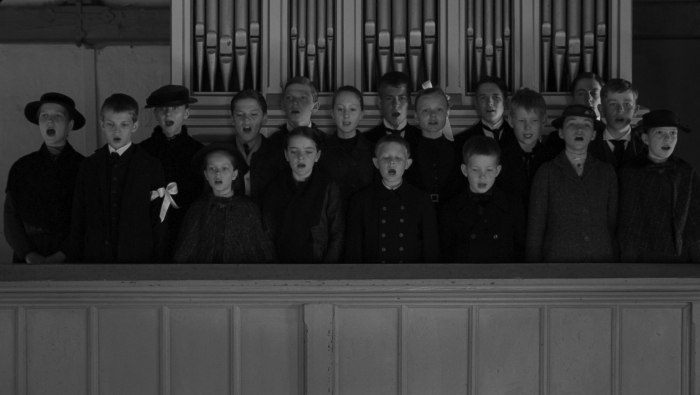
Various allotment of families is the centerpiece of this film. The overwhelming majority of the characters are characterized by and subsequently credited as their professions.
The pastor is overly repressive towards his children, yet when accusations are levied against them he retracts into his proverbial shell of self-defense. The abundantly similar characterization that can be made here is that of religion- overwhelmingly repressive, yet unwilling to commit to actual change.
The baron is the picture of wealth, yet when tragic events ensue he cannot bear to be anything but vindictive. The farmer’s son destroys his crops out of anger- the sort that this society manifests in young people- over the loss of his mother and in response the Baron cuts all funding to the family farm and fires the only other member of that family who earns a paycheck in the winter. When his child- Sigi- disappears and becomes ill, the newly-hired nanny Eva- who is not responsible for him- is relieved of her duties. The people of this town look for every excuse to avoid blame and in the process are compound the situation.
For example, Sigi travels with his mother and siblings to Italy and in the process completely recovers. It is as if the gloomy nature that oppresses the village and its residents creates all of the village’s issues. However, it is not a paranormal presence that is looming over them, rather it is simply just the attitudes of those in power.

One would be remiss to not mention the historical context of this time period. These very children were the generation that grew up to see their once great country devolve into poverty and followed it up by committing it to the radical agenda of a madman. This film provides the necessary historical resonance to justify its setting, however, it is not simply restrained to this period of time. Evil people grow frighteningly easily given the right mix of subjugation and neglect throughout the world.
The only seemingly decent person of the lot is the school teacher, who is our narrator. He admits that this is his point of view and given the suspicious circumstances around the town it is very believable that this would be his perspective.
The aforementioned cinematography of Haneke, when combined with his effervescence of silence approach create a lethal combination. Especially in black and white, this film seems bleak and grim and the solemn wide shots set to very minimal external sound create tightly wound tension. It is like a powder keg, a word often associated with pre-WWI Europe. One crack in the facade that this collective village has plastered around themselves and this tension is likely to cause combustion.
The film never puts this catastrophic explosion on screen, as it is implied. The damage is done over a period of four war-torn years and provides an aftermath of utter disaster. Each and every German town along the countryside resembled that of The White Ribbon, thus when the aftermath arrives the children with evil tendencies begin to question all that they know. Therefore, when Germany is confronted with the manifestation of evil they are more willing to accept it. This generation of Germans know that the past was riddled with thoughtless apathy, thus they turn to those who appear to care for them despite some very troubling flaws that would normally be considered startling.

Haneke does not wish to absolve the children of the story, as they still made condemnable choices in his film and presumably in the future. Yet, he wants to identify where such a propensity for hatred originated and that lies with their nurturing in a caustic environment.
One example of the delusion which plagued these children, whose perspective is rarely seen, is when Martin is prevented from walking on a precarious beam by the schoolteacher. Martin argues that if God intends for him to stop, then there must be some sign of it.
This mindset is severely unnerving in the fact that they are perpetrating acts of unthinkable violence and simply because they get away with it they are doing God’s will. That is exactly how the parents are responsible, living in denial allows the children to believe that God is in favor of their brutality and it desensitized them to brutish behavior from an inconceivably young age.
The most impressive work done by Haneke in this film is how methodically the story unfolds to the viewer. They are strung along slowly, first understanding the mindset of the town and then when he or she gets a clear view of the entire picture. A stunningly wicked picture at that. It is then amplified with horrifying realism due an uneasy silence that prevails as these events are unfolding.

This film has a genuine sentiment of truth to it. The aesthetic brought on by the black and white as well as the masterful cinematography is one that allows the audience to experience the events of the film as if they were historical events. This is the most vital element in producing a spectacle that contains the historical relevance of the White Ribbon. Haneke chooses an implicitly familiar historical context and engulfs his audience in it. Then he adds his ponderance on the origins of evil and his message is vividly clear.
Overall, this film is excellently crafted with a deeply meaningful message, an extremely authentic tone that encapsulates its context, a true vision from the director, and outstanding performances from every cast member. The only issue that can be levied its way is that the introduction to the film is ever so slightly askew. There is a combination of rapid narration and introductions of a wide assortment of characters- the vast majority are nameless. Therefore it can take about fifteen minutes or so to get into the flow of the film.
Such a minor complaint would likely evaporate on a second viewing, which this film certainly lends itself to. Haneke has created a readily important film because he raises certain questions which force the audience to cross-examine both history and the society in which they live.

 The Daily Review