By Joseph Romano
Spoilers ahead.
Greta Gerwig’s feature-length, directorial debut came with the 2017 release of Lady Bird – a film that explored the mother-daughter relationship. However, she did not impose limits upon herself in producing this film, as it also delves into the massive stress and perceived inadequacies that a finically induced predicament imposes upon a family. Above all else, the film feels genuine, as if it rose from a place of passion. The relationships in the film truly echo that of the real world, devoid of frills and at its core lies something more firm. At the heart of Lady Bird, Gerwig espouses a truly moving sentiment of self-realization for both of the film’s two most prominent characters – who are seemingly always at odds. While another film might have opted for the villainization of one in favor of the other, Lady Bird rather opts for a dynamic relationship in which both characters are flawed individuals and by its conclusion they separately come to terms with their respective shortcomings.
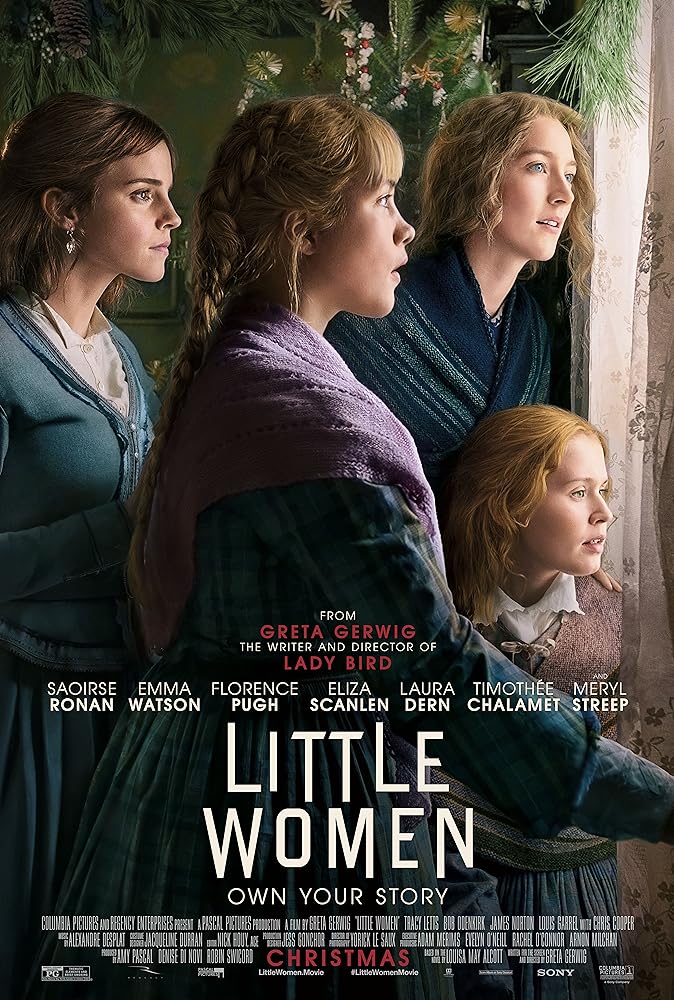
Similarly, Little Women examines the difficult world that women are made to face, a theme that is as prevalent as ever. The fabled tale, originally written by Louisa May Alcott, is seamlessly adapted for a modern audience, without the slightest hint of feeling archaic. In doing so, Gerwig is greatly aided by the enduring relevance of such ideas, however, the film is fully steeped in her individual style – distinguishing itself from past iterations.

The narrative darts between the present and past and yet is not even slightly confounding. As the audience views the film, he or she cannot only immediately recognize the timeline at which the events are occurring, but also understand its dire relevance to the present. The narrative imprints make these transitions evident and, further, the visual indicators – mainly in the form of color – leave no doubt in one’s mind as to where the events of the story fit into the larger narrative. Furthermore, this form of narrative does not simply flow well, but it also enhances the material.
The emotional core of the film is severely amplified based on the order of events that unfold. It is important to display the state of the characters in their respective timelines prior to their final convergence in the film’s closing moments. In doing so, it amplifies the emotional resonance of its most significant moments. Therefore, it provides a thrilling experience for the viewing audience, as well as allowing a deeper exploration into each of the richly developed characters.
A particularly stark moment is the film’s final shot. Jo March (Saoirse Ronan) had struggled through myriad years of attempting to publish her work – which as one might expect entails a fairly personal connotation. However, the systematic subjugation and public demand prevent this portion of herself to be put forward in an unabridged, sincere form. In a way, the rejection of her work is received as a rejection of herself and that is a highly damaging way for one to evolve his or her respective craft. The opening chapters of what soon became Little Women were the most personal of all, containing the fragments of a life sought after by the malevolent forces with which the film’s characters wrangle. Thus, their dismissal was enough to force one to the brink of abandoning her respective dream. Yet, a writer’s will reigns supreme in the end, as Jo’s countless attempts are finally manifested into her book.
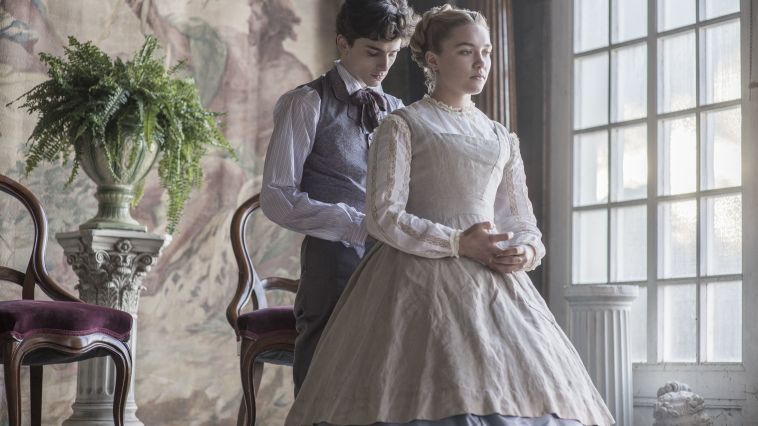
The poignant final shot exemplifies the entire film to a tee. The very thing that the hopeful writer strived for throughout many a year was finally attained. The intoxicating bliss of having the object of one’s tutelage – which is intrinsically part of oneself – be tangibly forged for everyone else is represented in the resultant unparalleled joy of this scene. The artist is indivisible from the art in that every piece of art is in one way or another a depiction of some portion of the artist. In the least obvious of cases, the artist’s craft allows personal, hidden truths to flow forth – aspects of oneself that he or she did not consciously place there. Therefore, Alcott inevitably saw herself in Jo and accordingly, Gerwig equally recognizes herself in both of them.
This finale is particularly emotionally resonant because – despite all of the tangential plots of family and love – the struggle of the artist is the emotional heart of this film. The struggle to create a work of personal significance, while also turning a profit is a timeless struggle. Surely no one is more aware of this than this film’s director. To a certain extent, this film flourishes in this category, as it secured a $40 million budget and a Christmas release, while also being wholly original and conveying a personal tone. That is unquestionably a difficult feat to attain, especially when considering the modern context of cinema. There is only a slight, narrow market for original pictures with meaningful goals, as the majority of the marketplace is occupied by trite and recycled material that is corporately produced as a means to sell merchandise and not produce art.
Another singular aspect of Gerwig’s film is the Alexandre Desplat score. Overpowering the audience with an operatic gale of piano and strings, then lulling them into a sense of security. It is most apparent at the very start of the film, as Jo runs in celebration of her publication the orchestra begins to enchant the viewer. The score plays a large role in one of the most essential aspects of the movie – its warmth and welcoming nature. Little Women has a seemingly innate ability to envelop the audience member into the world that the cast and crew labored tirelessly to create. It is framed by its aesthetic above all else and, for the entire run time, one can hardly separate themselves from this aforementioned world during their viewing.
In this process of inviting the audience in, the film only endears its emotional message more thoroughly to the viewer. It needs to highlight the importance of the artistic process, while also displaying why striving for such goals was particularly difficult for women in the context of the mid-nineteenth century. That message is not lost on a modern audience, as while the struggle for women to publish books may not be as dire as it once was, the disparity between men and women filmmakers is particularly stark. Therefore, despite the film’s status as being derived from centuries-old source material, it feels fresh due in large part to the fact that it is distinctly personal. A film such as this will always exude a particular sense of sincerity.
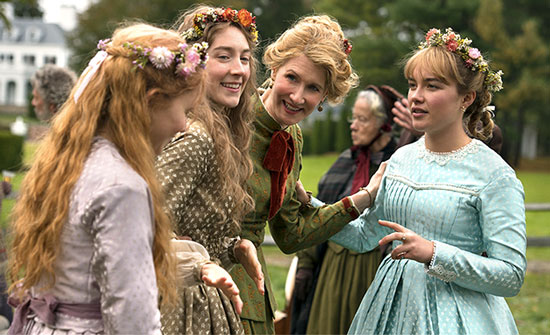
The emphasis on atmosphere is also an apparent stylistic choice by the filmmakers. Concord, Massachusetts certainly provides the classic New England aesthetic and within such an atmosphere the emotional depth of characters can be cemented. It inherently emanates with warmth, a quality which is undertaken in order to endear the principal characters of the story. They are complex people with a range of aspirations and the feelings engendered by their environment serves to further underscore the emotional resonance of these characters.
In contrast, the other locations that these characters travel to are accompanied by a stark reality. They are never really accompanied by fond, flowing music or the bright glow of autumn in New England. Rather, New York is adorned by a dreary industrial atmosphere and Paris is furnished with the hollow, ostentatious gildings of high society. In many ways, this echoes the heart of Alcott – and by extension Gerwig’s– story. Despite containing all of the ornaments of romance and historical intrigue common to a period piece, the genuine nucleus of the story is as simple as that warm atmosphere of the family home.

The cinematography of the film may not provide anything particularly striking, as it does more to emphasize its atmosphere. The wide shots wonderfully encapsulate this atmosphere, providing a contrast to the interior, tight-quarters shots where the film’s emotional message unfolds. The wide shots are taken slightly from a low angle and in many ways, it provides the impression as if these shots are meant to evoke the grandeur of a landscape painting.
All of such exterior shots typically contain houses and abundant nature – whether it be snow or that orange-brown tint of autumn – and minimal human interference. The slight tilt of the angle allows the viewer to receive the impression that he or she is gazing at a picturesque panorama, propped upon a prominent wall of one’s home or adorning the illustrious walls of a grand museum. The melding of the atmosphere with natural beauty in the cinematography is often juxtaposed against the positively ostentatious ornamentation of the lavish costume design with which Jacqueline Durran imbues this film.
The scope of Little Women does not resign itself to the simple, personal story of the film. Rather the pageantry is exhibited in full color, throughout the sumptuous masquerades, refined streets and ballrooms of Paris, and the dour streets of industrial New York. Each set of costumes is befitted to the respective scene – rarely glowing, yet always bright. The varied arrangement of dress often echoes the mood of the scene, where sullen moods are underscored with rich, yet muted colors. On the contrary, cheery dispositions are complemented with abundant reds and greens. This is particularly noticeable during the Christmas events, always celebrations of utter jubilation, which are accompanied by the merry tones of Desplat’s piano and distinct outfits, bedecked by seasonal colors.

Gerwig’s Little Women lies in the middle of the spectrum, somewhere in between the solemnness of The Age of Innocence and the mythical expanse of Barry Lyndon. Gerwig’s second feature-film does not strive for the same goals as these two films, nor does it approach the idea of the period piece in the same manner. However, her examination of these films manifests from a distinct perspective on a classic story, as told through a storied genre.
Above all else, Little Women celebrates and refigures the classic story, and its genre, as Gerwig’s alterations allow the material to appear fresh. The story of the March family is not necessarily the most relatable of tales – the struggle of an approximate middle-class family in a long-gone conflict may not catch most people’s immediate attention. Nevertheless, this iteration of Little Women is able to encapsulate a decidedly personal tale, which could appeal to even the most naïve viewer in respect to Alcott’s work.
The way in which the line between sentimental and overtly sappy film has been readily blurred in recent years of cinema, this film straddles that line with aplomb. It engenders sentiment, sorrow, and delight when necessary – all upheld by some of the finest craftsmen and women in their respective trades. With everything taken into consideration, this film is a revelation and an anomaly for the modern cinematic audience.

 The Daily Review