
By Joseph Romano
Spoilers Ahead!
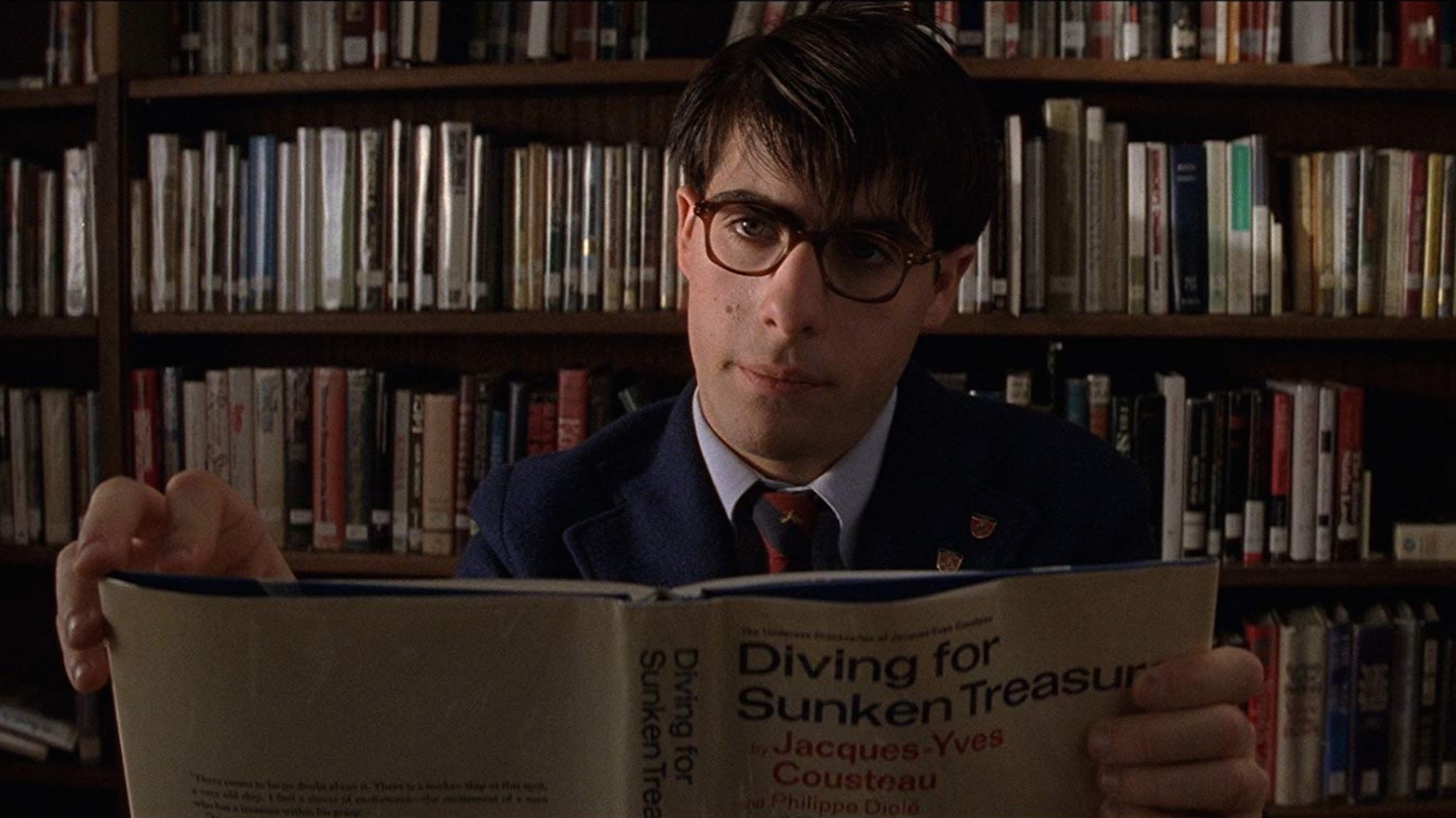
Under all of his bluster, Max Fischer (Jason Schwartzman) is just a sad kid. Unable to free himself from the traumatic loss of his mother, Max is intent on distracting himself with a restless productivity. Churning out plays on a typewriter gifted to him by his mother and hatching one scheme after the other to find someone to fill this gaping hole in his life, when he stops the specter of depression creeps in. His contrived ego has manifest itself as a defense mechanism, protecting him from his own grief. The answer to his problems were resting right in his own words, yet his boundless ego prevented him from realizing it.
“Sic Transit Gloria”, Max utters as he discusses the ‘dead language’ of Latin while introducing himself to Miss Cross (Olivia Williams). Glory fades. One cannot overcome their own sadness with their personal pride standing in the path. Max is banned from Rushmore, feuds with his close friend, and continuously embarrasses himself before he comes to realize this inalienable fact of life. We cannot progress when we are overly bogged down in our own ego, fueled by the pretensions of our supposed genius and propelled forward by the desire to get what we want exactly as we want it. This perspective is not equipped to manage pain because it is not adjusted to reality. Disappointment is as much ingrained in the human experience as is pain – and the ultimate hope for happiness. Once Max sheds his childish expectations, he is able to prosper and grow as a person. One who can see beyond the blinders of his own self-importance. To know this all you have to do is listen to the conclusory song, The Faces’ “Ooh La La”.
Max is not stranded in this abyss by himself. Herman Blume (Bill Murray) and Rosemary Cross – his two closest companions throughout the film – are mired there right beside him. Herman is departing a loveless marriage with two kids that have no respect for him when he befriends their Rushmore classmate, Max Fischer. At their birthday party Herman’s wife is not so subtly cheating on him with a younger man, as he despondently tosses golf ball after golf ball into an empty pool. Wielding a glass of liquor in one hand with a cigarette hanging from the corner of his mouth, as the viewer looks down upon Herman from above, he plummets into the depths of an uncertain, murky green pool. Without saying a word, the audience clearly understands the depths of his depression, set to the tune of The Kinks.
After the feud of friends, over the illustrious Miss Cross, settles Max and Herman meet up at the hospital. When asked about his current state, after a touch of hesitation Herman confesses, “I’m a little bit lonely these days.” Life takes a toll on all of the characters of Rushmore and they all must learn to grow out of the ashes of despair. They all want to care for each other yet cannot see past themselves. Distance and time do not heal these wounds fully, rather it provides them with the space to gain the perspective that they need to change in some way. These scars will never fully disappear, as they are the emotional variety and those have a tendency to linger. Loneliness might be inescapable, but by no means should it be self-consuming.

Miss Cross, it first appears, is not paralleled with these two sad people, providing a voice of reason. Yet the viewer soon comes to realize, she is still in love with her dead husband, Edward Appleby. She returned to Rushmore – where he attended high school – lives in his childhood home and set up a life there in order to ensure a closeness to him. They all display their faults and shortcomings – some more vibrantly than others. They have a reliance on one another in which they place all of their hopes upon the other person without any consideration. By the end, they still do not confess to these faults but attempt to move past them by being honest with themselves. For Wes Anderson, immaturity is not only reserved for youth. Adults can act as children – or the inverse – because humans are not stable beings, we change and grow and sometimes have lapses. The importance is that we are always learning to be better.
![Movie Project #26: Rushmore [1998] – The Warning Sign](https://twscritic.files.wordpress.com/2012/06/rushmore-1998.jpg)
Glory cannot fade when one pities his or herself, still unchanged is the fact that it must. To ascend from the abyss, one needs to look beyond themselves, instead focusing on those that they care for. This cannot compensate for the respective losses of Max and Miss Cross, but perhaps it could point them towards the future. Max embraces his new status, without the ego, in dedicating his final play to his mother and Edward Appleby. A gesture that supersedes any personal aspirations, rather opting for what is right and wholesome. It is obvious his longings will never fade, but without the haze of his hubris compromise between his extreme tendencies becomes possible. Glory can fade because nothing is sacred, not even ourselves.

 The Daily Review