By Joseph Romano
Spoilers Ahead!
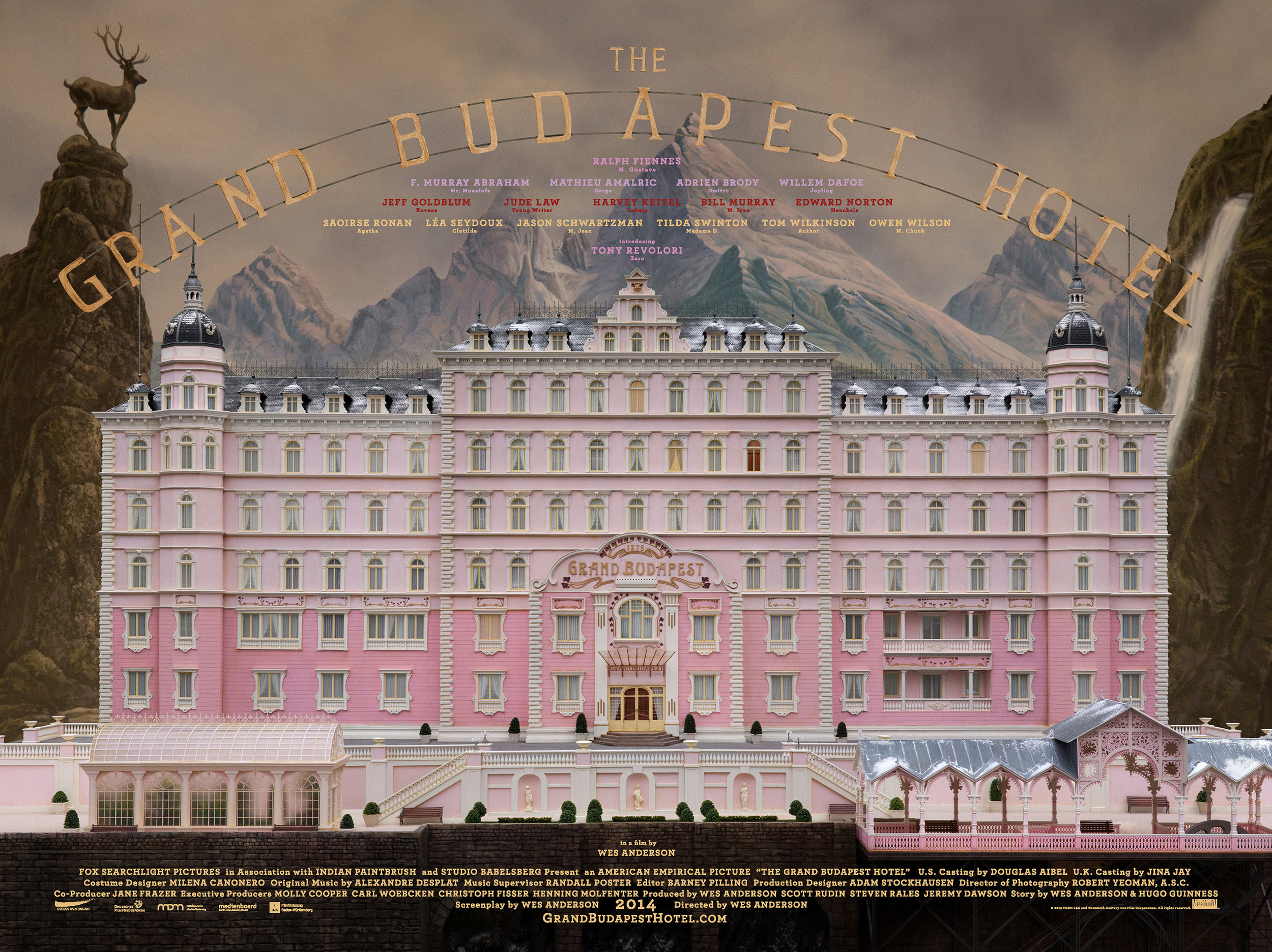
As intricately layered and meticulously designed as one of Mendel’s famous cakes and tightly wound as the aesthetic dynamics of every corridor and hallway of the titular hotel, Wes Anderson’s The Grand Budapest Hotel is more of an accomplishment than a film. It exudes color and enthusiasm yet has an overwhelmingly somber aura. The film examines the art of recounting the past in terms of glorification, reminiscing to a point prior to the bleak present. Also, holding not so subtle undertones that harken to the calamity that befell Europe in one of the darkest eras of human history – the rise of fascism and World War II.
The once majestic centerpiece of the historic state of Zubrowka, a relic of a bygone time, the legendary Grand Budapest Hotel stands firm as a pristine representation of the brightness that the past can hold. The present is far less uplifting, as the once resplendent exterior of the building is contrasted against the now desolate interior. The glory of the past does not match the lingering melancholy of the present. The building left a permanent mark on the state in which it resides, just as M. Gustave (Ralph Fiennes) had left a lasting impact upon Zero Mustafa (Tony Revolori and F. Murray Abraham).
When questioned as to why he kept the hotel by the Young Writer (Jude Law), Mr. Mustafa confesses that it was not for his mentor, the man he idolized, but rather his beloved wife Agatha (Saoirse Ronan). He did not need the building to keep a tether to what he remembers as a simpler world, which has since faded from existence. Rather, he understands that this time in his life could never be recalled, even in the form of an inherently familiar location.

Anderson’s eighth motion picture echoes the unbridled idealism of youth and the wistful melancholy of aging, the arduous toll that time enacts upon someone regardless of his or her emotional makeup. He beautifully reflects on these two perspectives; despite their dire contrast, they flow seamlessly together. The Grand Budapest Hotel, although unquestionably a Wes Anderson film, undercuts the standards of his lengthy filmography. All of his films are inherently cheery, upon the conclusion, told with a sense of gloom lingering under the surface. This entry, however, tells an ultimately melancholic story with a great degree of whimsy, abruptly ending just as it started. Reflecting upon his experiences, the writer, with a hint of remorse, admits, “It was an enchanting old ruin…but I never managed to see it again.”
In many ways, the grand old ‘ruin’ represents Europe before, during and after the second world war – Eastern Europe in particular. In spite of its glowing veneer, the events that surround The Grand Budapest Hotel are inevitably steeped in a lingering despair. When Mr. Mustafa is questioned as to the meaning of the hotel to him, he responds in a very frank manner – for him it was not a symbol of Gustave’s world because that world had disappeared long ago. Yet, he “certainly sustained the illusion with a marvelous grace.” History and the figures within it often have ingrained relationship to reminiscence, as “the good old days” is not a trope to be taken lightly.
The past will always be glorified by those who experienced it because for them it is a symbol of their youth. The past is teaming with life because if such moments were not lively, then is there any evidence that he or she truly lived. Further, many look to the past as a means to escape a bleak present, thus they extol it as a simpler time. This can easily be comparable to the post-World War II era, where destruction encompassed the continent – Zubrowka representing Eastern Europe and Old Lutz Germany.
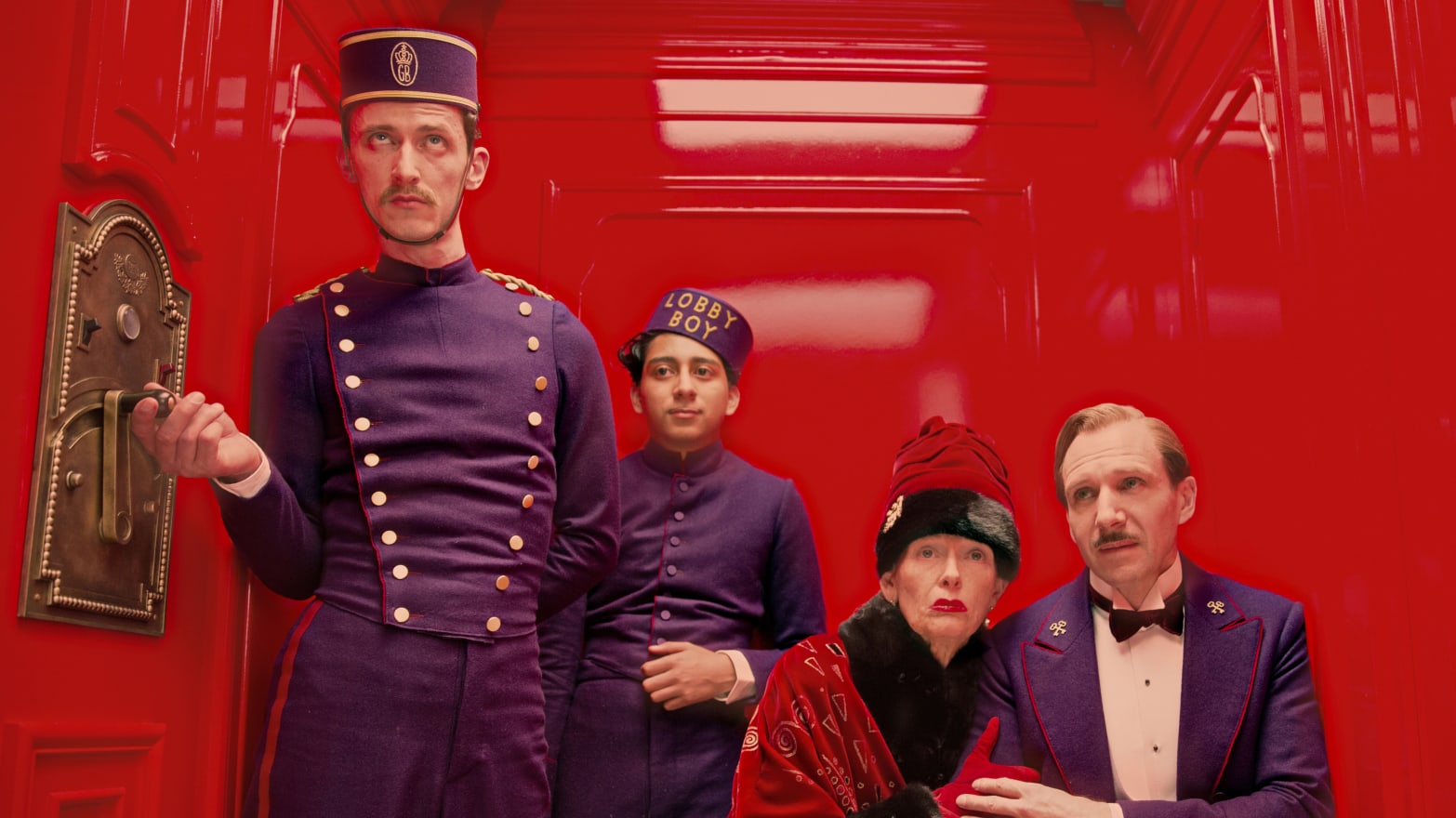
The hotel ran into ruin primarily because the state became war-ravaged and traveling to a luxury hotel became unfeasible both financially and safety-wise. The area that this film depicts was both decimated by extreme bloodshed and subsequently fell to the dominance of socialism in the form of the Soviet Union. The depressed impact can be seen in the opening and closing of the film, as the Young Writer encounters and learns the story of Mr. Mustafa, which would later evolve into his famous book, earning him a bronze statue in the Old Lutz Cemetery – pictured at the opening and conclusion of the movie.
The wonder of a Wes Anderson film is the ability to have such a staged and highly produced movie generate such resonant emotions. The concept of belonging is never far from the mind in his films and it is simple to understand why. Everyone wants to feel wanted, as if they belong to something greater than themselves – whether it is a family, group of friends, or a team. Zero and Gustave, at the start, are not shown to have any real family connection, thus their shared vocation aligns them. The eventual attempt to form a family inevitably ends in heartbreak, further emphasizing Mr. Mustafa’s inevitable loneliness. One who lacks the anchor of belonging has no direction, seeking to find the support he or she lacks. A lost soul lacks acceptance and is therefore doomed to wander through life with the fleeting hope of finding that much sought-after connection. That is exactly what we see in the form of the forlorn Mr. Mustafa. The audience understands these feelings because they are universaly human and can reach someone on the deepest level, despite the film’s sometimes-frivolous appearance.

Another theme, often seen in Anderson’s films, is the tragic impact of death upon a person. Mr. Mustafa lost his wife and child at a young age; thus, he has become overrun with sorrow and loneliness. Teary-eyed, he proclaims that, “even at the thought of [Agatha’s] name, I am unable to control my emotions.” The story thus brushes over her in many ways, she is clearly present, but the camera is often just gazing at her, as opposed to engaging with her character more actively. This is not an oversight, but a credit to Anderson’s brilliance as a visual storyteller. He is allowing the audience to see and experience the story from the perspective of Mr. Mustafa, as her absence points to the inner loneliness of the storyteller. Anything else would not be genuine.
Films like Rushmore and The Royal Tenenbaums underscore, for Anderson, how one never really does get over death. He or she can try to cope with the loss, but it will define his or her actions for the rest of life. The more devastating the loss, the larger the impact. Their outlooks are not bleak, they are rooted in a depressive mist and garnished with a glimmer of hope. This allows the audience to embrace the idea of a happy future, while also not washing away the underlying anxieties of the past.
Although The Grand Budapest Hotel does not quite follow this same structure, it too emphasizes the impact loss has upon one’s life. Without stories, or art by extension, we would be deprived of the past and the emotion that make a life worth living. Life is an experience and its hardships must be embraced as Mr. Mustafa does in order to share his story, however unpleasant the process of it is to him. Embracing these hardships makes life meaningful, from the perspective of Wes Anderson, even though the more difficult aspects of it cannot – and perhaps never will be – relieved. This movie is a heartening gift wrapped in a somber package. The fact that there is something below a surface level that is glowing with lavish decorations makes this film all the more valuable.

 The Daily Review