By Joseph Romano

Spoilers Ahead.
The Coen Brothers have certainly accumulated quite the reputation for oddity. Typically, they rely upon situational humor, emanating from the absurd situations that endlessly intriguing characters place themselves into. They have made a career from the irregularities of life. Yet, with possibly the most unique entry into their catalogue, No Country for Old Men does quite the opposite. It is a film most prominently driven by the one constant universal to all human life – death. It does not heed at the call of anyone and, more importantly, it always lurks in the shadows, undetected. Except when it doesn’t.
As is often the case, No Country for Old Men can be briefly surmised as an unfortunate situation vastly exceeding its fathomable boundaries. This film stands out in a sense because its specific differences are so drastic – the most profound one being its oppressively dark tone. Thematically, No Country for Old Men subverts the trademark of the Coen’s by so thoroughly penetrating through its quality of restraint. Not that the film does not visualize its message, rather it simply conceals it in a tale patently characterized by its humanity and therefore its faults. One can either remain stringent in his or her conviction and will themselves to the belief that he or she can conquer each and every opposing force that he or she will encounter. Or conversely surrender to the unwavering drive of fate, ready to be besieged by malevolent forces, to expect the unexpected.
But, can one adequately do so? Here lies the conversation between the characters of Llewelyn Moss (Josh Brolin) and Sherriff Ed Tom Bell (Tommy Lee Jones). The classic Western tropes of the cowboy and lawman, respectively, personified. With such logic, Brolin’s Llewelyn is the common man – doing all in his power to extricate himself from his lackluster lot in life – while Sherriff Bell is the sage whose life has suddenly passed him by – a fact undisclosed to him until it was too late. Bell suddenly realizes he was in over his head, as an irreparable streak of death begins to plague him. Anton Chigurh (Javier Bardem) is the epitome of death for the characters if the film, his shrouded presence is only discernible as he strikes his fatal blow. Death comes for everyone in No Country for Old Men, however, the Coens emphasize just how distinctly it reaches each individual.

Moss denies this fact and is brutally snuffed out for it – in fact his blustering poise prevents him from protecting his wife. His state of denial, blissfully unaware of his destitute condition, and the overwhelming belief in his ability to defend himself, and by extension his wife, is ultimately his undoing. Moss was a welder and lived in a trailer park with his wife, where their scant existence was a point of great discontent from him.
While never being explicitly stated, his insatiable desire to keep his newfound wealth proves his willingness to risk all in his power to escape his current state of being. Perhaps, he is reeling from the irreparable damage enacted by serving two tours in Vietnam or simply the stagnation of modern life – or a combination of the two. The fact remains that he was willing to forsake the stability of his life for the allure of a more prosperous one, however wrought with danger it might have been. The common man often aspires to disentangle himself from the barbs of mediocrity and Llewelyn is squarely presented this opportunity in the form of a leather carrier bag, filled to the brim with one-hundred-dollar bills.
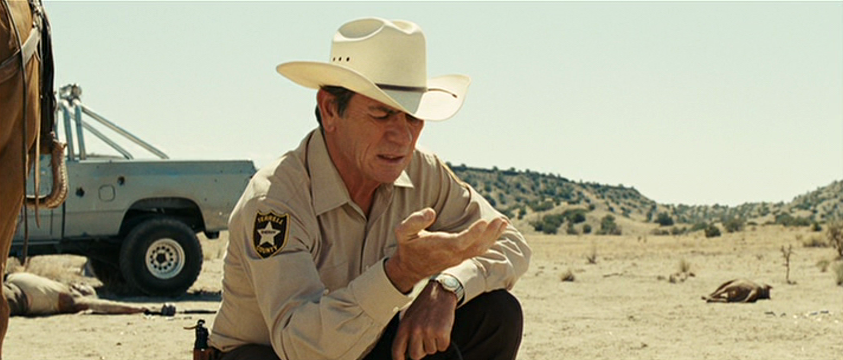
Similarly, Ed Tom Bell is resigned to his own fate, but he fully accepts it. As the title implies, he is an “old man”, outliving his father by twenty years per his admission, and he is simply not suited for what the world has become. Chigurh constantly serves as a reminder for the characters to accept their fate, as their entire lives were leading up to that fateful movement. Often leaving their lives to a simple toss of the coin, he is acknowledging that no one is in outright control of his or her life and proves it time and time again.
He cannot see that a car is about to blind-side him, just as the gas station clerk could not see the menacing threat in the shape of a coin, and Llewelyn could not recognize the inevitable fate of his situation. Sherriff Bell, conversely, recognizes that he is outmatched because the world has changed before his eyes and any attempt, he makes to protect those in need is ultimately futile. By virtue of this, he is not dealt the immediate bolt of a cattle gun, but rather the meandering path of impertinence that he is wandering, as foretold by his conclusory dream.
Aside from outright death, another theme that this film delves into is that of fate’s impact. It seems to beckon the question: what are the repercussions for our actions? Llewelyn Moss, the archetypal hero, is slain off screen at the most pivotal juncture of the film. He, along with a slew of cartel members and bounty hunter Carson Wells (Woody Harrelson) among others ultimately encountered death in the same manner.
Death did not single out Moss because of a single lapse in morality, rather he put on a consistent display of his morals. In this way the Coens are able to represent the invariability of death, enveloping the just and wicked all the same. Any decision can equate to Chigurh’s toss of the coin – Sherriff Bell’s lingering outside of the motel room door, for instance. Enter and test your fate or walk away and let fear claim you, this is the conundrum he faces.
The film’s most steadily cautious character, Sherriff Bell readily understands the forces he is grappling with. By virtue of his age, he also inherently has much more of an understanding of the unrelenting nature of death. Moss shows no such discernment and despite his ever-present caution, he still succumbs to its woes because he fooled himself into the faulty belief that he was in command.
Ironically, perhaps the most vivid personification of ultimate doom since The Seventh Seal, the forces Moss inevitably succumbs to are members of the Mexican cartel, born from a simple slip of the tongue. If nothing else, this basic fact blatantly underscores the dubiousness with which the mystic forces, beyond human comprehension, operate within the confines of this film. Whether embodied by unbridled greed, overconfidence, bluster, or simply resilience; Anton Chigurh came for all those who stood in his path, transgressing upon his twisted moral code.

He punishes the innocent and guilty alike, as from his perspective, morality is intrinsically linked with acceptance. Carla Jean’s (Kelly Macdonald) deep cutting analysis of Chigurh’s motivation earned her the decency of a death without the leering eye of the camera. Her words cut straight through his impenetrable veneer: “the coin [doesn’t] have [a] say, it’s just you.” By refusing to partake in his process, his façade is removed, and he is left bare for all to see. Therefore, he is revealed as a man, one who is aging and suspectable to the same fate as all of his victims. To further this point, the Coens strategically have the blind side car crash unfold in the aftermath of this vital scene. He meagerly hobbles away from the sight of the accident, resigning himself to the reality of his world.
The imperious blackness of No Country for Old Men is the uncompromising element that completes the nasty whole. However, it is not solely draped in despair, as it portrays the world as a dynamic one. Once one accepts his or her fate, he or she can proceed in an evolving world. Sherriff Bell’s dream also presents a hopeful image for the future, as he experiences a genuine proximity with his long-deceased father.
He has the inherent understanding that whatever may come of the world in which he lives, his father will be there awaiting his arrival. It may be a sliver of hope in an ultimately bitterly dark world, yet its positioning as the finale offers a brighter perspective for the future. In the transitory time of the 1980’s, as generational change revolutionized the cultural zeitgeist, the Coens provide the idea that perhaps change should not always be despaired. If embraced, then potentially the uncertainties of life may not seem so grim.

 The Daily Review